 BYTEASSUREStart a review
A pre-launch pentest price for one small web app and its API, tested by a person, works out at roughly £3,000 to £6,000 in the UK. That figure is our arithmetic rather than a survey: three to five tester-days at the £1,000 to £1,200 day rates UK firms publish (sources in the table below). In the US, Blaze Information Security publishes $4,999 to $8,999 for a simple SaaS app. Anything much cheaper is either a very tight scope or mostly automated, and both can be fine as long as you know which one you are buying. The harder question for an early startup is whether you need a pentest yet at all, or whether a cheaper review answers the question that is actually keeping you up.
We will take that question first, then how pentests are priced, the published prices (with links, read in November 2026), what makes a cheap pentest risky, what the report must contain and how to cut scope sensibly. For how to write the scope itself, see what a credible penetration-test scope should say.
Do you need a pentest or a review?
A pentest is a specific product. A qualified tester attacks an agreed target within agreed rules, then writes a report that a third party can read and rely on. The UK's National Cyber Security Centre describes it as a method for gaining assurance, and its penetration testing guidance makes the point that a pentest checks your own vulnerability management rather than replacing it. That framing matters for startups. If you have no vulnerability management yet, a pentest will mostly find the things a cheaper review would have found, at a higher day rate.
You probably need a pentest now if any of these is true:
- A customer's security questionnaire asks for one. Enterprise procurement questionnaires often ask whether an independent third party has tested the application in the last twelve months, and for an executive summary or attestation letter. A review or scan report rarely satisfies that line.
- You are preparing for SOC 2 or ISO 27001. Neither framework has a line that simply says "buy an annual pentest". ISO 27001 asks for technical vulnerability management and security testing (Annex A 8.8 and 8.29 in the 2022 version), and SOC 2 auditors look for evidence that controls are evaluated. In practice a recent third-party pentest is the evidence most auditors and customers expect to see. Ask your auditor what they will accept before you buy.
- A contract, insurer or investor requires it. Read the clause. Some name a methodology or an accreditation (CREST in the UK, for instance), and a test that does not meet the wording will not satisfy it.
If none of those applies (and choosing a security review covers the alternatives), the risk that matters before launch is usually narrower: can one customer read or change another customer's data, are any secret keys public, and is payment state trustworthy? Those are answered faster and more cheaply by a focused review. The pentest can come when the first enterprise deal asks for it.
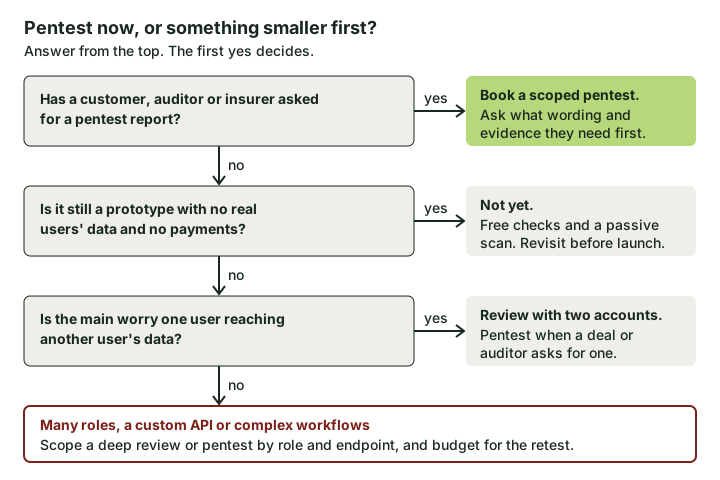 The first yes decides. If nobody has asked you for a report yet, the third question is usually the one that matters.
How pentests are priced
Almost every pentest price is days multiplied by a day rate, whatever the invoice calls it. Fixed prices are the same sum done in advance against a written scope.
The day count depends on:
- Roles. Each role (visitor, member, admin, organisation owner, support staff) has to be tested against every other where it matters. Two roles is a small job. Five roles with per-organisation permissions is not.
- Endpoints and functions. A typical small SaaS app has a few dozen API routes or edge functions. Each one that takes an ID is a place to test whether it checks ownership.
- Authentication flows. Sign-up, invitations, magic links, password reset, SSO and MFA each add time, and they are where account takeover bugs live.
- Environments and hosts. One production-like environment is cheapest. Testing staging and production separately roughly doubles some of the work.
- Access. A greybox test (accounts and documentation) or a whitebox test (source code too) finds more per day than a blackbox test where the tester must discover everything from outside.
- Reporting and retest. Writing a report someone can act on takes real time. A retest of fixed findings is often a fixed add-on, sometimes a day, sometimes included.
A worked example (ours, not a vendor's quote). One web app, two roles, around thirty API routes, one staging environment that mirrors production, accounts provided. A tester might reasonably scope three days of testing and part of a day for reporting. At the £1,200 day rate one well-known UK firm publishes, that is about £4,800 before VAT, with a retest on top unless included. Change the app to five roles and an admin console and it can double. That is why a good tester asks questions before quoting and a bad one does not.
Published pre-launch pentest prices, UK and US
These are figures vendors publish themselves, each checked on the linked page on 12 November 2026. They move, so follow the link before you budget.
| Source | Published price | Notes |
|---|---|---|
| Pen Test Partners, G-Cloud 15 pricing (UK) | £1,200 per day for web application assessment and for API testing | Days set by a scoping process. Excludes VAT |
| Stingrai pentest cost guide (UK) | Median £1,000 per day | From 30 rate cards on the government's G-Cloud 14 framework. Central band £800 to £1,200 |
| Blaze Information Security (US and UK) | Simple SaaS app $4,999 to $8,999 over 3 to 7 testing days | Indicative day rates of $1,600 to $2,800 in the US and £800 to £1,200 in the UK. Its packages include one round of fix validation within 90 days |
| Astra Security (US) | $5,999 per manual pentest; $2,999 for the autonomous tier | One target, defined as a web app and the APIs it consumes. Expert tier includes two re-scans within 30 days |
| Intruder (UK and US) | AI-powered web app pentests from $3,500 a test | Sold alongside its scanning subscriptions |
| Security Arsenal (US) | $1,400 for one production web app, authenticated and unauthenticated | Described as an agent swarm driven by an experienced tester. Includes report and remediation retest |
Read the AI-assisted offers carefully: Astra's $2,999 tier, Intruder and Security Arsenal. They are not the same product as a few days of a person's time at a day rate. That is not a criticism: AI-assisted and autonomous testing is a real and improving category, and for some startups it is the right first purchase. But a buyer's questionnaire that asks for a manual penetration test by an independent tester may not be satisfied by it, so check the wording before you pick on price.
What makes a pentest cheap, and when cheap is risky
There are honest ways to be cheap: a tight scope, a small app, code access that saves discovery time, a tester with low overheads. And there is the dishonest one, which is an automated vulnerability scan with a pentest cover page.
Signs that a "pentest" is a relabelled scan:
- No scoping call and no questions about roles. A tester cannot plan authorisation testing without knowing what roles exist.
- No request for test accounts. Without them, everything behind the login is out of reach, which for a SaaS app is most of it.
- Turnaround measured in hours for a fixed fee. Scans are fast. Manual testing of thirty endpoints across two roles is not.
- Findings are all generic. Missing headers, TLS cipher notes, a jQuery version. Every one of them is real and none of them requires a person.
- No rules of engagement. A real test needs written permission, a window and an emergency contact before anything is sent at your app.
- A "certificate of security". Nobody can certify that. A pentest report describes what was tested, what was found and what was not tested.
The risk is not just wasted money. It is false comfort. A clean scan report on an app where user B can read user A's invoices by changing an ID is worse than no report, because now someone believes the app was tested.
What the pentest report must contain
The NCSC lists the essentials: the issues found, the risk of each, a way to fix each, and an opinion on how accurate your own vulnerability assessment was. For a startup handing the report (or its summary) to customers, add the following:
- Scope and dates. Exact hostnames, environment, roles tested, testing window and the version or commit tested.
- Who tested. A named tester or firm, and any accreditation the customer asked for.
- Method. Whether it was blackbox, greybox or whitebox, and the reference used, such as the OWASP Web Security Testing Guide.
- Evidence for each finding. The request sent, the response received, steps to reproduce, impact and a specific fix. Screenshots alone are weak evidence.
- Severity with a stated method. CVSS or a clear in-house scale, adjusted for your context and explained where it departs from the default.
- Limitations. What could not be tested and why: a role nobody provided, a payment flow excluded, an unstable environment.
- Retest results. Which findings were fixed and verified, and which remain open. Customers will ask.
- An executive summary or attestation letter you can share without handing over exploit details.
How to cut pentest scope sensibly
Cutting scope is how you get a startup-sized price. Cutting the wrong part is how you waste it.
Cut:
- The marketing site, if it is static and hosted separately. It carries little risk and a passive scan covers it.
- Duplicate environments. Test one staging copy that matches production, with production-like configuration.
- Third-party platforms. You cannot authorise testing of Stripe or Supabase's own infrastructure anyway; test your use of them.
- Denial-of-service and load testing. Rarely worth paying for at this stage.
Keep:
- Every role that real customers will hold, and at least two separate organisations or accounts so isolation can be tested.
- Sign-up, invitations, password reset and anything that changes a role.
- Every endpoint or function that takes an ID and returns or changes a record.
- Payment state: what unlocks paid features, and whether it depends on a verified webhook.
Do before the test, to save days:
- Fix what free tools find. Run your database advisor, grep your build output for secret keys and fix the dependency advisories. Paying £1,200 a day for someone to report RLS switched off is poor value.
- Do a two-account check yourself (the five checks are here), or have one done. If user B can read user A's data, you want to know before the tester's clock starts, because the pentest will find it on day one and spend the rest of the time around it.
- Give code access and documentation. Greybox or whitebox testing covers more in fewer days.
- Prepare accounts, seed data and a named contact for the testing window.
- Book the retest window and plan your fix sprint to land inside it.
If that list makes a pentest look premature, it probably is, and our 5-day two-account check at £449 is the smaller step (it is not a pentest, and the report says so). If a customer has already asked for a pentest report, our penetration test is £2,999 fixed for one small web app and its API, with written rules of engagement and one retest. That price only holds because the scope is small and written down, and it is the scope, not the price, that you should check first.