 BYTEASSUREStart a review
How much does a security audit cost for an app you built with AI? The vibe coding security audit cost runs from nothing (a free advisor in your database dashboard) to several thousand pounds for a manual penetration test. Going by published prices as of November 2026, automated scanners sell for tens of dollars a month, fixed-price human audits of a Lovable-style app are listed at $1,000 and from £1,500 (ours is £449), and manual pentests from established vendors start at several thousand. The spread is not random. It tracks one thing more than any other: whether a person will sign in as two different users and try to cross the line between them.
This article is about the price. If you want to know what an audit actually checks, read what a vibe coding security audit checks first. If you are still deciding between a scan, a review and a pentest, choosing a security review covers that decision. Here we look at what moves the number, what real vendors publish, what you lose at the cheap end and how to read a quote.
What drives vibe coding security audit cost
Five things account for most of the difference between two quotes for "an audit of my app".
Scope. One app on one domain with two roles is a small job. Add an admin console, a mobile app, a public API, three Supabase edge functions and a Stripe integration and you have roughly tripled the surface. Good quotes count things: hostnames, roles, functions, tables. Vague ones say "your app".
Code access. A reviewer who can read your repository (or your Lovable project, read-only) finds the edge function that queries by whatever id the request sent in minutes. Without the code they have to discover it from the outside, which takes longer and misses more. Code access usually makes the work cheaper per finding, not more expensive.
Test accounts. This is the big one. Cross-account bugs, where user A can read or change user B's rows, only show up when someone holds two sessions and swaps IDs between them. No accounts, no cross-account testing. A quote that does not ask you for test users is not testing access control, whatever the sales page says.
Manual versus automated. Automated tools are cheap because the marginal scan costs almost nothing. Human time is the expensive input, and it is spent on the checks a tool cannot do: does this policy express what the business meant? Can a member promote themselves to owner? Does the success page unlock the product without a verified payment?
Retest and fixes. A recheck after you fix things is real work (someone has to repeat the failing requests and confirm they now fail properly). Some providers include one, some charge for it, some do not mention it. Fixing is a separate job again, usually quoted after the audit. Read which of these is in the number.
Published prices as of November 2026
These are prices vendors publish on their own pages, each checked on the linked page on 12 November 2026. They change, so follow the link before you rely on one. Currencies are as published, and UK prices may exclude VAT.
| Tier | Example | Published price | What the page says you get |
|---|---|---|---|
| Free built-in check | Supabase Security Advisor | Free in the dashboard | Lints such as tables without RLS and policies that are always true on writes. It leaves a read policy of using (true) alone and cannot tell whether an owner check matches the business rule |
| Free built-in check | Lovable Quick and Deep scans | Free | Quick scan runs in the publish dialog; Deep scan reviews the code for access control, secrets, payment and data exposure issues |
| Automated scanner | Vibe App Scanner | Go $29 a month, Pro $49 a month | Live-app and code scans with copy-paste fixes. The pricing page does not say it tests one user against another |
| Platform pentest | Lovable with Aikido (docs) | Announced at $100 a test in March 2026; the docs price it at 100 Aikido credits a test until the end of June 2026 | An AI-run test of several hours with your repository, billed through a paid Aikido account. Authenticated testing only if you add test users |
| Autonomous pentest | Astra Pentest Auto | $2,999 per pentest, or $199 a month | Automated pentest of one target with one human re-scan, available for 30 days |
| Fixed-price human audit | RapidDev Lovable security audit | $1,000 fixed for a standard Lovable app | Read-only review including RLS, auth and secrets, about five business days. Fixes quoted separately, with the audit fee credited; no retest mentioned |
| Fixed-price human audit | SpotDev Safe to Ship | From £1,500, ex VAT | Engineer review priced by risk tier, with a walk-through call. The page treats a penetration test as a different check |
| Manual pentest | Astra Pentest Expert | $5,999 per pentest | Manual testing by certified testers alongside autonomous agents, two expert re-scans available for 30 days |
Two caveats. The $100 was a launch price. The docs give the cost in Aikido credits and tie the 100-credit rate to the end of June 2026, a date that has now passed, so check your Aikido plan before assuming $100. And "from" prices are floors. A risk-tiered quote for an app that sells to other businesses will not be the floor.
The announcement of Lovable's pentest feature put a traditional pentest from a specialist firm at $5,000 to $50,000. That is a vendor's framing, not a survey, but it is the right order of magnitude for manual work by an established firm.
What each tier covers, and what a cheap scan will miss
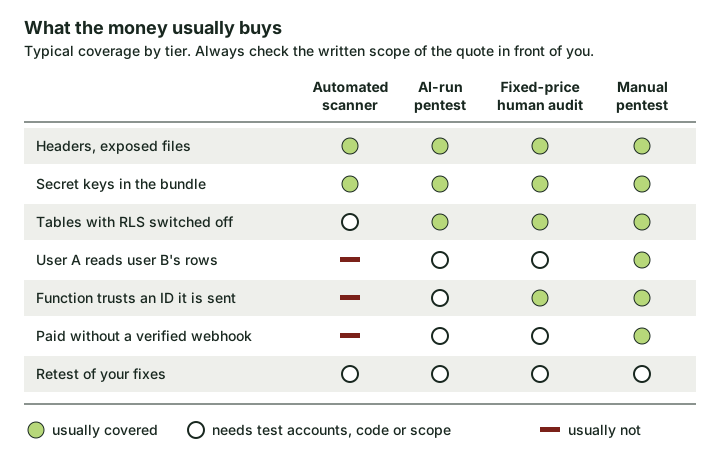 Typical coverage, not a promise from any vendor. The hollow circles are where the written scope decides whether you get the check.
The pattern in the grid is the whole argument of this article. Every tier finds the same top two rows: missing headers, an exposed .env, a Stripe sk_live_ key or a Supabase secret key sitting in the JavaScript bundle. Those are worth finding, and if a $29 scan finds one, it has paid for itself many times over.
The rows that cost money are the ones underneath, because they depend on what your app is supposed to allow:
- A read policy that says
using (true). RLS is enabled, and Supabase's always-true lint deliberately skipsSELECTpolicies because some tables are meant to be public. Any signed-in user (or anyone with the public key, depending on the role it applies to) can still read every row. We recorded this happening in theUSING (true)demonstration. - An edge function that uses the secret key and trusts the ID it is sent. The secret key bypasses RLS, so the function is the only gate. A scanner sees a 200 response and has no idea whose record came back.
- A role column the user can update.
profiles.rolewith an update policy ofauth.uid() = idlets every user make themselves an admin. Nothing about it looks broken from outside. - Payment state set by the browser. Landing on
/successshould not unlock anything. Only a verified webhook from Stripe should.
An AI-run pentest can find some of these if you give it test users and your code, which is why those cells are hollow rather than red. A human audit should find most of them if it has code and two accounts. What none of the cheaper tiers will do is tell you something is fine when they never tested it, unless the report is badly written. Which brings us to quotes.
Red flags in a vibe coding security audit quote
Most bad quotes are not dishonest. They are vague, and vagueness lets a scanner report pass for an audit. The full list of what a credible proposal should state (targets, access, authorisation, deliverable, who does the work) is in how to scope and compare quotes. These are the flags that bear on price.
- No request for test accounts. If they do not ask for at least two users (and two organisations, if your app has teams), they are not testing whether customers can see each other's data, and you are paying audit money for scanner coverage.
- A price with no count behind it. A fixed price should rest on a written number of hostnames, roles and functions. "Comprehensive" with no list means you cannot tell what the money bought.
- A sample report with no requests in it. Each finding should show the request that was sent, the response that came back and the fix. If the sample is all headers and library versions, that is what you will get.
- A flat "pass" or a certificate. Nobody can certify an app as secure. A report that says "no high-risk issues found" should also say what was not tested.
- Retest silence. If the quote does not say whether a recheck is included, assume it is not, and ask what it costs.
- The fix is the real product. An audit that comes with a large remediation quote attached is not wrong in itself (some apps do need work), but get a second opinion on the findings before you sign the bigger cheque.
One flag that is not a red flag: a low price. A small, fixed scope done properly can be cheap. The question is never "why so little?" but "what exactly will you do for this?"
Lovable security audit price, and the built-in option
If you build in Lovable, you have a free first pass already. The publish dialog runs a Quick scan, you can run a Deep scan from the project's Security view, and Lovable's docs say both are free. The Aikido integration adds a paid AI-run pentest that reads your repository. Use the free scans before you pay anyone. Add test users to the Aikido authentication instructions; the docs are clear that without credentials the test is limited to flows that do not need a login, which leaves out most of the interesting part of a SaaS app.
Then decide what the automated result leaves open. If it found nothing, the useful question is whether anything actually tried user B's token against user A's records, and whether a person read your RLS policies as sentences. You can do a version of that yourself with the five checks for whether other users can see your data. If you cannot spare the afternoon, or the app takes money, that is the gap a paid human audit fills. Third-party Lovable audits run from about $1,000 to £1,500 and up on the published pages above.
How ByteAssure's fixed prices compare
Our prices are published too, so here they are on the same terms.
| Offer | Price | Access needed | Tests one user against another? | Retest |
|---|---|---|---|---|
| Snapshot | £149 | Public URL only | No. Passive; does not test database rules or access control | None listed; the £149 is credited if you continue to the two-account check |
| 5-day two-account check | £449 ($569) | Written permission, two test users, read-only code | Yes, read, change and delete across two accounts | One recheck |
| Deep review | £2,249 | Code, roles, payment flows | Yes, across roles and tenants, plus business logic | One recheck of priority fixes |
The £149 snapshot is the scanner tier done by a person: it will catch the top two rows of the grid and nothing below. The two-account check sits in the fixed-price audit tier and is built around the fourth row. It covers secret keys in the bundle, tables readable with the public key, private files and Stripe webhook verification, and it reports within five working days of access with the request and response for every check. If a check in scope has no request and response in the report, it is not charged, and the £449 comes off the fix invoice if a fix starts within 14 days. It is not a penetration test, and it does not certify the app as safe to launch. The deep review is for apps with several roles, sensitive data or payments complex enough that the business logic itself needs testing.
We are not the cheapest option in the table, and for a prototype with no real users you should not pay us or anyone. The fair comparison is price per check that matters, and in particular whether the price includes someone trying the request as the wrong user.
Spending less without buying less
A few things lower any quote, ours included.
- Fix the free findings first. Run the Supabase advisor, Lovable's checks and a bundle grep before booking. Paying someone to tell you RLS is off on a table is the worst value in this market.
- Give code access. Read-only access to the repository saves the reviewer hours of guessing, and those hours are what you are paying for.
- Prepare the accounts. Two users in two separate organisations, with realistic data, ready on day one. Waiting for accounts burns days on fixed-time engagements.
- Name the out-of-scope parts. If the marketing site is static Webflow, say so and take it out.
- Ask for the recheck window. Plan your fixes so they land inside it.
And if a quote still feels high, ask the provider to split it: what does the access-control testing alone cost? That number, more than the headline, tells you whether you are buying an audit or a scan.